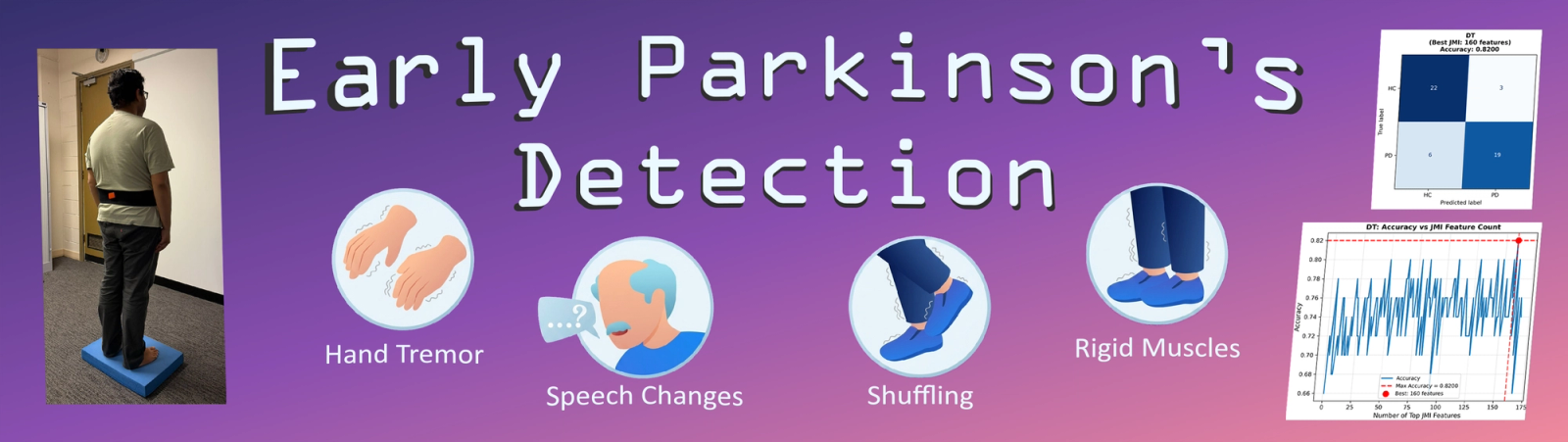
AI for Early Detection and Monitoring of Parkinson's Disease
Research ProjectParkinson’s disease is a progressive neurological disorder that affects movement, balance, gait, and a range of cognitive and behavioural functions. Although clinical diagnosis is based on neurological examination and medical history, these assessments are often subjective and may not fully capture how symptoms change over time or in response to medication. As a result, there is a growing need for objective, data-driven tools that can support clinicians in monitoring disease progression and treatment effectiveness.
This project aims to develop an Artificial Intelligence (AI)-enabled framework for the objective assessment of Parkinson’s disease. The framework combines multimodal sensing technologies, including neurological, physiological, and movement-based sensors, to provide a more comprehensive evaluation of disease symptoms. Information from multiple sensor modalities will be analysed to identify digital biomarkers that distinguish people with Parkinson’s disease from healthy individuals and quantify changes in motor performance before and after medication.
The project will deliver an objective, interpretable, and clinically relevant AI framework for Parkinson’s disease assessment. The identification of the most informative sensing technologies and digital biomarkers has the potential to support earlier diagnosis, personalised treatment monitoring, and the development of next-generation digital health tools for neurological care.
Published papers
Showing the 3 most recent of 6 publications.
Computers in Biology and Medicine
Early-stage Parkinson’s disease detection using multimodal brain–body biomarkers from fNIRS and IMU data
Maryam Sousani, Raul Fernandez Rojas, Elisabeth Preston, Maryam Ghahramani
Journal article · IEEE Transactions on Neural Systems and Rehabilitation Engineering 33, 984–993
Exploring brain-body interactions in Parkinson’s disease: a study on dual-task performance
M Sousani, RF Rojas, E Preston, M Ghahramani
Conference paper · 12th International IEEE/EMBS Conference on Neural Engineering
fNIRS-Based Classification of Parkinson's Disease During Standing Balance Tasks
M Sousani, Y Baradaran, HS Minhas, RF Rojas, M Ghahramani